

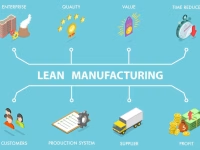
Lean Manufacturing Principles focus on maximizing value by eliminating waste within a manufacturing system. It aims to improve efficiency, reduce costs, and enhance quality by streamlining processes and optimizing resource utilization. Lean principles are widely used in various industries to improve productivity and customer satisfaction.
Key Principles of Lean Manufacturing:
- Value:
- Define value from the customer’s perspective. Value is anything that the customer is willing to pay for. This means understanding customer needs and aligning processes to deliver exactly what the customer wants without unnecessary steps.
- Value Stream Mapping:
- Map the entire production process to identify all activities involved in the creation of a product, from raw material to finished goods.
- Value Stream: The flow of materials and information that creates value for the customer.
- Value Stream Mapping (VSM) helps identify waste and areas for improvement.
- Flow:
- Strive to create a smooth, continuous flow of materials and information throughout the production process.
- Eliminate bottlenecks, delays, and interruptions that disrupt the flow of production and reduce overall efficiency.
- Pull:
- Implement a pull system, where production is driven by actual customer demand rather than forecasted demand.
- Products are only made when needed, reducing overproduction, inventory buildup, and waste.
- Perfection:
- Continuous Improvement (Kaizen): Strive for perfection by continuously evaluating and improving processes. Even small, incremental improvements can lead to significant gains over time.
- Engage employees at all levels in the organization to identify inefficiencies and suggest improvements.
- Waste Elimination (Muda):
- Lean focuses on identifying and eliminating Muda (waste) from processes. There are 7 types of waste commonly recognized in Lean manufacturing:
- Overproduction: Producing more than needed.
- Waiting: Idle time while materials, people, or equipment are waiting.
- Transport: Unnecessary movement of materials or products.
- Extra Processing: Unnecessary steps or overcomplicated processes.
- Inventory: Excess inventory that isn’t being used.
- Motion: Unnecessary movements of workers or machines.
- Defects: Rework and corrections due to errors.
- Lean focuses on identifying and eliminating Muda (waste) from processes. There are 7 types of waste commonly recognized in Lean manufacturing:
- Standardization:
- Standardize best practices to create consistency, reduce variation, and ensure that every task is performed in the most efficient way.
- Standard Work: Establishes consistent procedures and benchmarks for each task to minimize errors and improve productivity.
- Jidoka (Automation with a Human Touch):
- Empower workers and machines to stop production when problems arise. This allows for immediate correction of issues to avoid defects and quality problems down the line.
- Focus on building quality into the process at every stage, rather than inspecting quality at the end.
- Just-in-Time (JIT):
- A key Lean principle that focuses on producing and delivering products at the right time, in the right quantity, and with minimal inventory.
- JIT reduces waste associated with overproduction and storage and improves the flexibility of the manufacturing system.
- Respect for People:
- Lean recognizes that employees at all levels play a crucial role in continuous improvement.
- Engage and empower workers by encouraging collaboration, providing training, and valuing their input in problem-solving.
Benefits of Lean Manufacturing:
- Improved Efficiency: Streamlined processes and reduced waste lead to faster production cycles and lower operational costs.
- Higher Quality: By eliminating defects and standardizing processes, Lean helps produce higher-quality products.
- Cost Reduction: By minimizing waste and improving resource utilization, Lean reduces overhead and operational costs.
- Increased Customer Satisfaction: Lean’s focus on delivering value to customers ensures that products meet customer expectations in terms of quality, price, and delivery time.
- Employee Engagement: Lean principles encourage teamwork, employee involvement, and innovation, leading to a more motivated and engaged workforce.
Lean Manufacturing is a powerful approach for improving operational efficiency, enhancing product quality, and creating a more agile and responsive manufacturing environment. By consistently applying Lean principles, organizations can create lasting value for both customers and employees.
Curriculum
- 10 Sections
- 10 Lessons
- 10 Days
Expand all sectionsCollapse all sections
- Day 12
- Day 22
- Day 32
- Day 42
- Day 52
- Day 62
- Day 72
- Day 82
- Day 92
- Day 102

Limited time offer R1,000.00
More Courses

Working in Confined Spaces
R3,000.00
Working at Heights Safety
R2,000.00
Ergonomics in the Workplace
R1,000.00


